Classroom Chaos to Control: The Strategy Teachers Don't Talk About
Many teachers walk into classrooms completely unprepared for the reality of student behavior and classroom management. In this interview, Mr. Herrera shares how he turned classroom chaos into control during his difficult first years of teaching while also discussing consistency, routines, lesson planning, and the emotional side of teaching.
6/6/2026
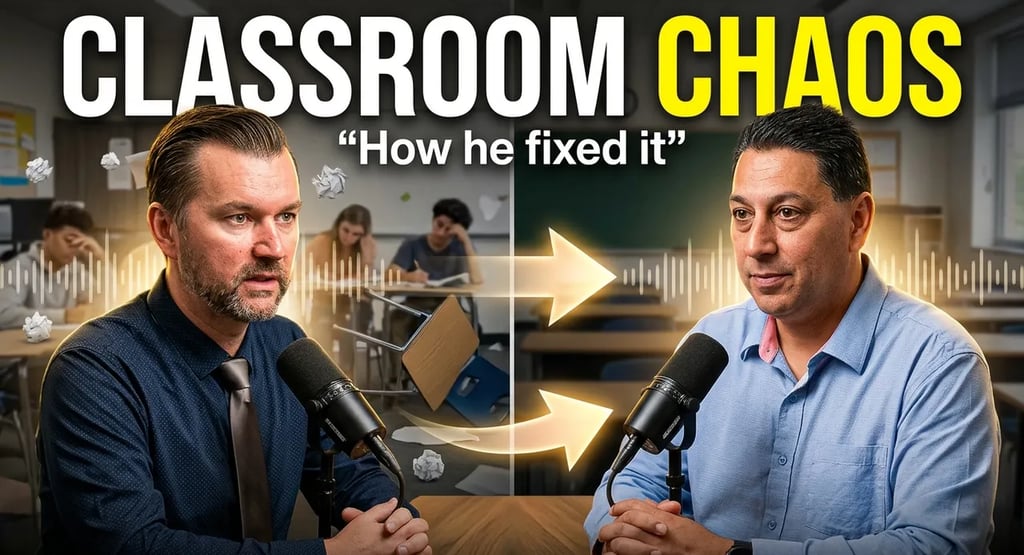
There’s a huge difference between learning about teaching… and actually becoming a teacher.
That was one of the biggest themes in my in-person conversation with Mr. Herrera, an 8th grade science teacher who shared what his first few years in education were really like.
And honestly?
A lot of teachers are going to relate to this story.
🔹 Walking Into Classroom Chaos
After the pandemic, Mr. Herrera accepted his first teaching position at a middle school in Riverside.
The problem?
The previous teacher had already left after only two weeks because they “couldn’t deal with the kids.”
So Herrera walked into a classroom that was completely out of control.
Students pushing over desks
Paper balls flying
Constant disruptions
No routines
No structure
He described it as a nightmare.
And honestly, many first-year teachers know exactly what that feels like.
What stood out to me most was this:
He didn’t focus on teaching content first.
He focused on classroom management.
That’s the reality newer teachers often aren’t prepared for. Before students can learn, the classroom has to become structured and predictable.
According to Herrera, it took about two to three weeks of consistency before things finally started settling down.
🔹 Why Consistency Matters So Much
One of the biggest themes throughout the interview was consistency.
Herrera explained that students need:
Clear routines
Follow-through
Consequences
Structure
Predictability
And he admitted something many teachers struggle with:
He naturally wants to connect with students and be friendly.
But once students start viewing you more as a friend than a teacher, classroom management becomes much harder.
That’s something many teachers learn the hard way.
🔹 The Power of Routines
One of the most interesting parts of the conversation was how routines completely changed his classroom.
Students walk in and immediately:
Take out their Chromebook
Grab their notebook
Start the warm-up
Follow the timer on the screen
Simple.
But powerful.
Herrera said the timer became one of the biggest game changers in his classroom.
Students stopped asking:
“What are we doing?”
“How much time is left?”
Because the systems answered those questions automatically.
That’s the power of routines.
🔹 Why Lesson Planning Systems Save Teachers
Another major takeaway was lesson planning.
Herrera explained that he uses about six main lesson formats repeatedly throughout the year:
Close reads
Notes
Simulations
Notebook checks
Mystery activities
Interactive notebook work
Instead of reinventing lessons every single day, he rotates familiar systems and changes the content inside them.
And honestly?
That’s smart teaching.
Because one of the fastest ways teachers burn out is trying to create completely new lessons every single day.
🔹 Why Substitute Teaching Helps
We also talked about substitute teaching.
And both of us agreed:
Substitute teaching may actually be one of the best ways to prepare future teachers.
Why?
Because substitutes walk into unfamiliar classrooms constantly and must manage behavior immediately.
No relationships
No routines
No ownership of the classroom
That experience forces teachers to develop classroom management quickly.
🔹 The Emotional Side of Teaching
One of the hardest moments in the interview came when Herrera talked about nearly being rehired at his first school.
He volunteered constantly.
Helped at events.
Received strong evaluations.
Built relationships.
And still…
Administration unexpectedly told him they were “going a different direction.”
That moment blindsided him.
And unfortunately, many teachers have experienced similar moments in education.
Teaching is emotional work.
Teachers invest huge amounts of energy, time, and heart into this profession.
🔹 Final Thought
What I appreciated most about this conversation was the honesty.
Teaching is rewarding.
But it’s also exhausting.
Classroom management is difficult
Consistency is hard
Students test boundaries constantly
The emotional side of teaching is real
But despite all of that, Herrera kept moving forward.
And that resilience matters.
If you want to watch the full podcast episode with more details, click here:
👉 https://www.youtube.com/watch?v=DnIniNC_vPY&list=UULFQOIbqNhb_gseSVU6bE3uUA