Classroom Routines That Actually Work | Student Engagement Tips
Many classrooms struggle with behavior and engagement because routines aren’t clearly defined or consistent. This post explains six essential routines that create structure and make your classroom run smoothly.
5/27/2026
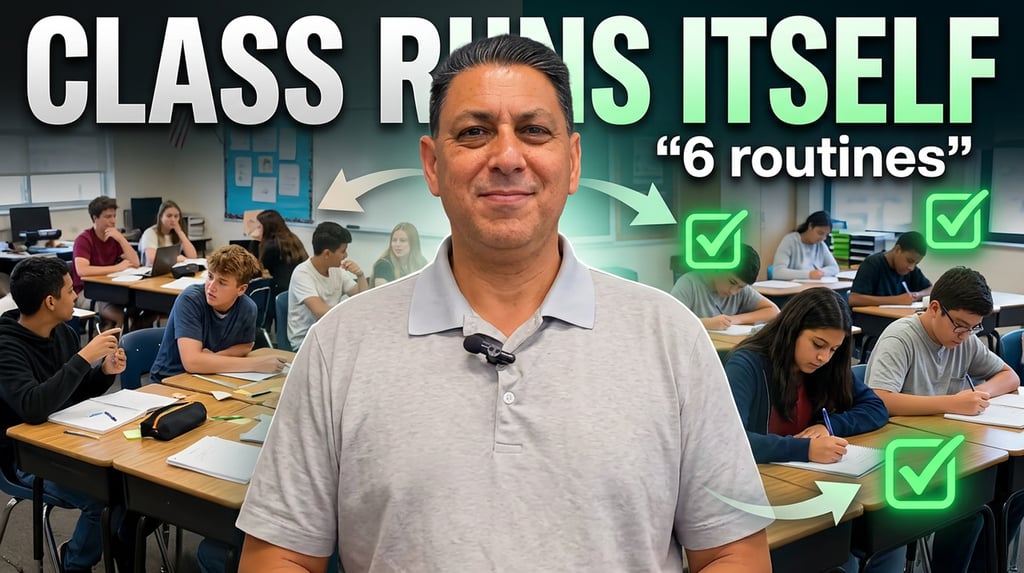
Let’s start with something you’ve probably heard a hundred times:
“Routines, routines, routines.”
It’s easy to hear. It’s easy to say.
But actually implementing routines in your classroom? That’s where it gets challenging.
And here’s the reality:
If you get your routines right, your classroom will start to run itself.
In fact, once these are in place, a large portion of your class can operate without constant direction. But there’s one condition.
Consistency is everything.
🔹 Why Consistency Matters
A routine only works if it’s followed every single day. It has to become automatic—for both you and your students.
It doesn’t take long either. Within about two weeks, routines start to stick. But if you don’t establish them, something else takes their place—and usually, it’s behavior you don’t want.
🧠 Consistency builds habits
🔁 Habits reduce decision-making
💪 Less decision-making = more control
🔹 Routine #1: The Warm-Up
The first five minutes of class will make or break your entire period.
If students walk in and nothing is ready, things start to drift quickly. Students talk, move around, and before you know it, you’ve lost control of the tone.
Instead, your routine should be clear and consistent.
🚪 Be at the door
📋 Have a task ready on the board
⏱️ Give students about a minute to settle in
After that, you can take attendance, answer questions, and handle small issues—while students are already focused.
🔹 Routine #2: End-of-Class Routine
The last few minutes of class matter just as much as the first.
Without structure, those final minutes can easily turn into wasted time or behavior issues. A clear routine solves that.
Wrap up the lesson, give students a final task, and guide them through turning in work and preparing to leave.
One important detail:
⚠️ No gathering at the door
That’s where pushing, noise, and chaos start. Keep students in their seats until you dismiss them.
🔹 Routine #3: Getting Student Attention
You need a consistent way to get the class focused.
Not something you try occasionally—but a routine that is practiced and expected.
In this case, a simple verbal cue followed by a pause works. You give the direction, wait, and expect full attention.
👀 Eyes on you
🤫 No talking
⏳ Wait time matters
If expectations aren’t met, track it and follow through. That consistency is what makes the routine effective.
🔹 Routine #4: Transitions
Transitions are where many classrooms lose momentum.
The space between activities often leads to talking, distractions, and lost time. The solution is to remove that gap as much as possible.
Be prepared ahead of time. Have materials ready. Move students quickly from one task to the next without downtime.
🔁 Think one step ahead
📄 Materials ready early
⏱️ Keep things moving
Even planned breaks should feel structured. The goal is a smooth flow from start to finish.
🔹 Routine #5: Passing Out Papers
This is one of those small routines that makes a big difference.
Without a system, passing out papers takes longer than it should and interrupts the flow of the lesson. With a routine, it becomes quick and predictable.
👤 Use student helpers or rows
📋 Keep it consistent every time
Students should always know exactly what to do.
🔹 Routine #6: Collecting Papers
Collecting papers should be just as structured.
In this system, students turn in their work as part of the end-of-class routine. They move through the process smoothly—turning in papers, gathering materials, and returning to their seats.
📥 Turn work in
🎒 Grab materials
🪑 Return to seat
Simple, controlled, and efficient.
🔹 Final Thought
If you put these six routines in place, your classroom will feel completely different.
Less chaos
More structure
Better behavior
Stronger engagement
The hardest part is the beginning. Those first couple of weeks take effort because you’re teaching the system and reinforcing expectations.
But once it’s in place, everything becomes easier.
Your classroom doesn’t just function—it runs on its own.
If you want to watch the full video with more details, click here:
👉 https://www.youtube.com/watch?v=M3RwysNf8gI&list=UULFQOIbqNhb_gseSVU6bE3uUA