Culture Eats Strategy for Breakfast | School Reality
Many teachers focus on strategies, but behavior is really driven by classroom culture. This post explains three key mindset shifts that help you stay in control and prevent problems before they start.
6/3/2026
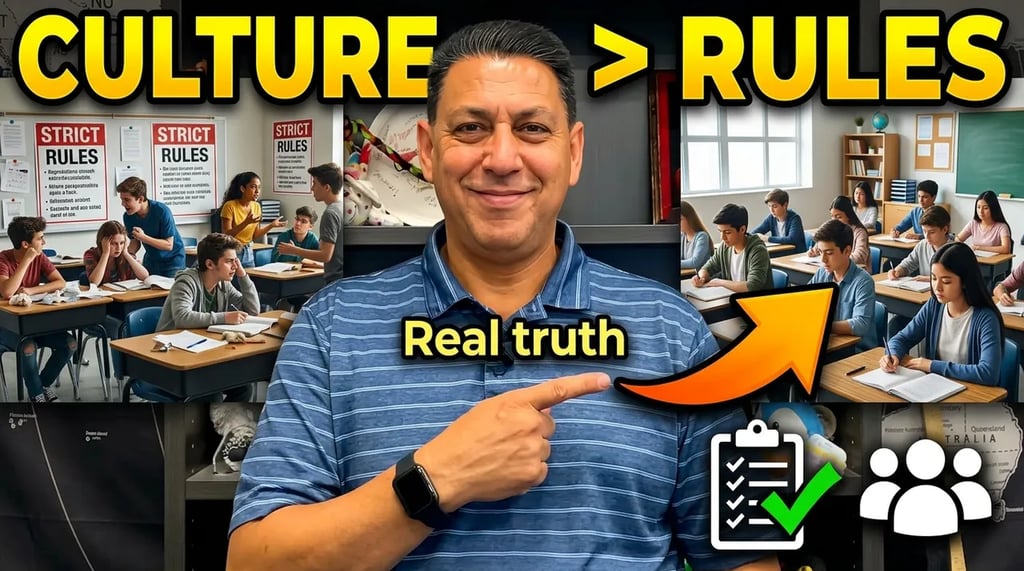
Classroom behavior can feel overwhelming.
It’s one of the biggest challenges teachers face—and it’s easy to feel like you need a better strategy, a better system, or a better plan.
But here’s the truth:
What really drives behavior isn’t strategy—it’s culture.
And once you understand that, everything starts to change.
🔹 Step 1: Don’t Take It Personally
This is one of the hardest things to do as a teacher.
A student says something disrespectful. They push back. They act out. And in that moment, it’s easy to feel like it’s directed at you.
But it’s not.
When students act out, there’s usually something deeper going on. They’re dealing with something outside of your classroom, and you’re simply the outlet.
Once you understand that, it changes your response.
🧠 You stay more centered
😌 You react less emotionally
🔁 You focus on guiding behavior instead of fighting it
And that’s where things start to improve.
🔹 Step 2: Identify the Triggers
Every classroom has triggers.
These are the small moments that lead to bigger problems.
Sometimes they seem harmless at first—a student makes a noise, the class reacts, and suddenly you’ve lost five minutes of instruction.
That’s what I call the snowball effect.
A small issue turns into a big disruption.
Here’s a real example.
A teacher was struggling with a student who kept distracting the class. It seemed like the student was the problem—but when we traced it back, we found something interesting.
It started with something simple:
The student didn’t have a pencil
That led to moving seats
That led to sitting with friends
That led to talking and disrupting the class
The real issue wasn’t the behavior—it was the trigger.
If that first problem had been solved, everything else could have been avoided.
The same idea applies in your classroom.
Think about your own situations. When something goes wrong, take a step back and ask:
What caused this in the first place?
Once you find that starting point, you can begin to prevent it.
🔹 Step 3: Focus on the 10-80-10 Rule
This is one of the most powerful ideas in classroom management.
In any class, you have three groups:
10% of students who will always do well
10% who will consistently struggle
80% who are influenced by the environment
That middle group is everything.
They respond to your classroom culture.
If your classroom is structured, consistent, and focused, that 80% will move in the right direction. If it’s not, they’ll move the other way.
This changes your goal.
Instead of trying to reach 100% perfection, focus on this:
🎯 Get about 90% of students on track
💪 Build systems that support consistency
🔁 Let culture do the heavy lifting
When you do that, something important happens.
You free up your energy.
Instead of managing the entire class, you’re now able to focus on the small group that needs the most support.
🔹 Final Thought
You don’t need a perfect strategy.
You need the right focus.
Don’t take behavior personally
Identify the triggers
Build a strong classroom culture
Because when your culture is strong…
Everything else becomes easier.
If you want to watch the full video with more details, click here:
👉 https://www.youtube.com/watch?v=Wopa5K_Hcmw&list=UULFQOIbqNhb_gseSVU6bE3uUA