Difficult Students? Here's What to Do
Dealing with difficult students can quickly turn into frustration and power struggles. This post explains a simple 3-step system to stay calm, maintain control, and guide behavior effectively.
5/20/2026
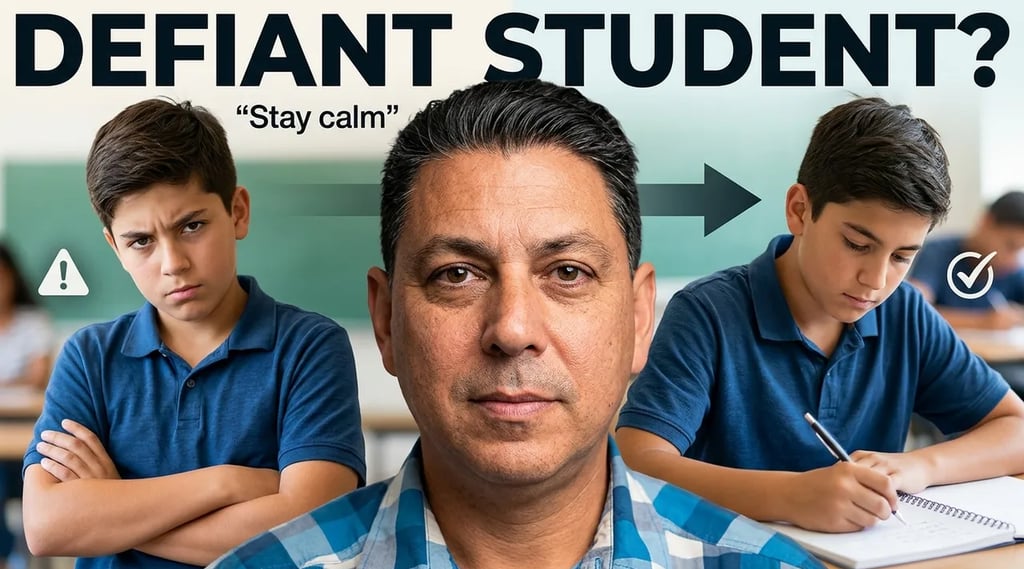
Let’s be honest for a second.
Teaching would be one of the best jobs in the world… if it wasn’t for difficult students.
Now, that’s partly a joke—but there’s truth behind it. What makes teaching difficult isn’t the content. It’s behavior. And more specifically, it’s those moments when a student pushes back, ignores directions, or challenges you in front of others.
The good news is this: there’s a simple system that works.
🔹 Step 1: Have a Plan Before It Happens
Before the school year even begins—or before a situation comes up—you need to already know how you’re going to respond.
Take a moment and think through the most common situations you’ll face:
💬 Students not quieting down during transitions
📱 Phones being used when they shouldn’t be
🚶 Students leaving class too often
⚠️ Behavior starting to escalate
These are not rare situations. They are guaranteed.
So the question becomes:
What will I do when this happens?
When you have a plan, you don’t hesitate. You don’t react emotionally. You simply follow through. And that immediately puts you in a position of control.
🔹 Step 2: Stay Calm in the Moment
This is where things usually break down.
A student ignores your direction. Maybe they challenge you. Maybe they do it in front of the class.
In that moment, it’s easy to feel:
😠 Disrespected
🤯 Frustrated
💬 Ready to react
But here’s the key idea:
Your tone matters more than your words.
Instead of reacting, keep it simple and controlled:
“Hey John, this isn’t your assigned seat. I need you to move.”
That’s it.
No lecture
No explanation
No emotion
Then walk away.
This gives the student space to respond without feeling challenged in front of their peers. And more often than not, that space leads to compliance.
🔹 Step 3: Avoid the Power Struggle
This is where many situations go sideways.
The moment discipline turns into a back-and-forth, you’ve entered a power struggle—and that rarely ends the way you want.
If you escalate, things change fast:
🗣️ Your voice gets louder
🎯 The student feels called out
⚠️ The situation becomes personal
Now the student feels like they have to respond. Not because they want to behave—but because they feel cornered.
Instead, your goal is to guide behavior without forcing confrontation.
🔹 Use Progressive Discipline
A better approach is what I call progressive discipline:
Step 1 → Calm reminder
Step 2 → Clear restatement
Step 3 → Consequence
Each step becomes more direct—but never more emotional.
And just as important, each step gives the student a chance to make the right choice.
🔹 Give Students an “Out”
This is one of the most important parts of the system.
Students care about how they look in front of others. If you back them into a corner, they will push back just to save face.
But when you:
Give a direction calmly
Walk away
Come back if needed
You’re giving them a way to comply without embarrassment.
That’s how you prevent small issues from turning into big ones.
🔹 Final Thought
Difficult students aren’t going away. Every classroom has them.
But the difference between a chaotic classroom and a controlled one comes down to how you respond.
🧠 Have a plan before problems happen
😌 Stay calm when they do
⚠️ Avoid turning it into a power struggle
Because at the end of the day:
Your goal isn’t to win the moment—it’s to change behavior.
If you want to watch the full video with more details, click here:
👉 https://www.youtube.com/watch?v=vP9SsE8_448&list=UULFQOIbqNhb_gseSVU6bE3uUA