TEACHER Speak Out About Group Work Effectiveness
Group work is often encouraged, but it doesn’t always lead to better results in the classroom. This post breaks down the challenges and shows how to make collaboration more effective.
5/2/2026
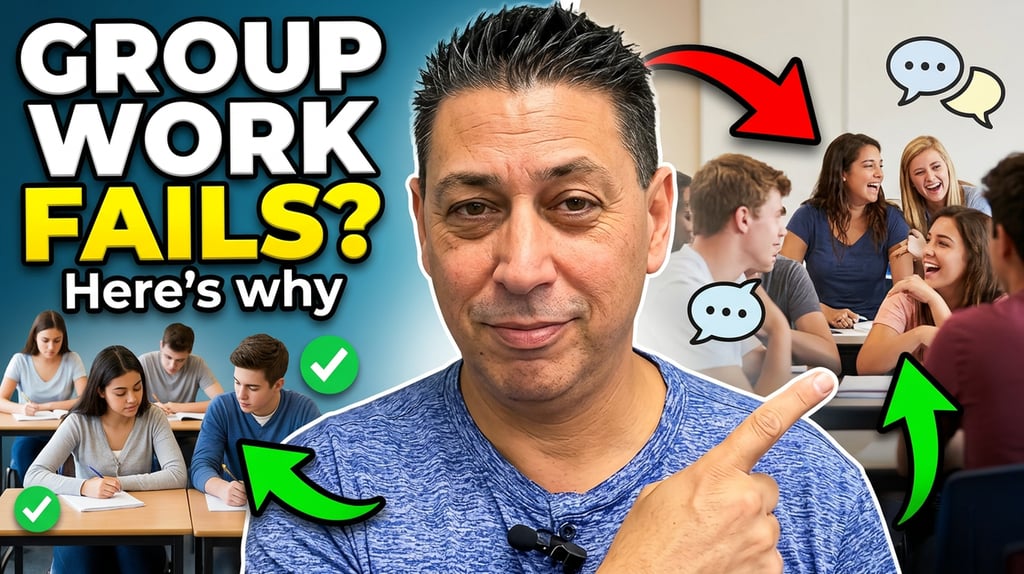
Every teacher has heard it.
“Use more collaboration.”
“Use more group work.”
It sounds great in theory. Students working together, sharing ideas, and learning from each other. But the reality in the classroom is often very different.
In fact, some of my worst classroom experiences have come from group work.
That doesn’t mean it can’t work—but it does mean we need to be honest about what actually happens.
Let’s start with the setup.
If your goal is group work, you’re probably arranging desks so students face each other. That setup naturally encourages conversation, which is exactly what you want—at the right time.
The problem is that conversation doesn’t always stop when it should.
When you need students to listen, focus, or follow directions, that same setup becomes a distraction. You’re now working against your own classroom structure.
Then there’s the issue of time.
Group work almost always leads to lost instructional time. Students get off-task. Side conversations start. You spend more time bringing the class back than actually teaching.
That doesn’t mean nothing is happening—but it does mean you’re trading control for collaboration.
And that tradeoff doesn’t always pay off.
I wanted to test this for myself.
So I ran an experiment. For about a month or two, I went all in on group work. Everything was done in groups—learning, assignments, even tests.
I wanted to see if it would truly improve outcomes.
Here’s what I found.
First, not all students like group work. About a third of my students were uncomfortable with it. Even when I let them choose their own groups, some students just didn’t enjoy that environment.
Second, there were constant side conversations. Staying on task became a challenge.
And third—and this was the most important—the results didn’t improve.
Students didn’t perform worse, but they didn’t perform better either.
So what did that tell me?
Group work does not automatically lead to better learning.
And in many cases, it requires more energy, more classroom management, and more effort from the teacher.
That doesn’t mean you should avoid it completely.
But if you’re going to use group work, it has to be structured the right way.
One strategy that works is how you form groups.
Instead of letting students choose based on friendships, create balanced groups. Take your class list and rank students based on performance. Then combine higher-performing students with middle-range students.
This helps create a balance where students can support each other without dragging the group down.
Another strategy is to avoid going all in.
Instead of structuring your entire classroom around group work, keep students in pairs. This allows you to maintain control during instruction while still giving students opportunities to collaborate.
When you want group work, you can quickly combine pairs into groups. With the right routine, this transition can happen in seconds.
That flexibility gives you the best of both worlds.
In the end, the goal is not just collaboration—it’s learning.
And sometimes, too much group work gets in the way of that.
So before you fully commit, take a step back and ask yourself:
Is this helping students learn—or just creating more noise?
Because the answer to that question will determine how effective your classroom really is.
If you want to watch the full video with more details, click here:
👉https://www.youtube.com/watch?v=OklcMHrrJKc&list=UULFQOIbqNhb_gseSVU6bE3uUA